ここから本文です
TWO:

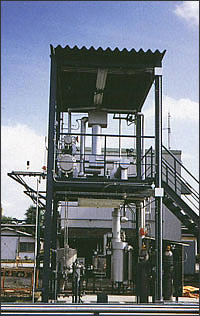
Membrane separation type solvent dehydration system

Great attention is recently being paid to global environmental issues, and it is now conceivable that companies will need to treat used solvents themselves. In consideration of this kind of social issue, we have developed a “membrane separation type solvent dehydration system,” which uses a polyimide membrane with superior dehydration properties developed by Ube Industries, Ltd. in combination with our own distillation and concentration technology that has resulted in solvents being more easily recovered.

THREE:In the meantime the Irish State trial, and the affairs of Ireland generally, were the subject of frequent discussions in both Houses of Parliament. On the 13th of February the Marquis of Normanby moved a resolution condemnatory of the policy of the Government, contrasting it with his own Administration, with the treatment of Canada, and with the liberal policy by which, he said, Austria had conquered disaffection in Lombardy. He was answered by Lord Roden and others, and on a division his motion was rejected by a majority of 175 to 78. On the same day the state of Ireland was introduced by Lord John Russell, in a speech which occupied three hours. The debate that followed lasted for nine days. The principal speakers who took part in it were Mr. Wyse, Sir James Graham, Mr. Young, Sir George Grey, Lord Eliot, Mr. Shaw, the Recorder of Dublin, Lord Howick, Lord Stanley, Mr. Macaulay, Sir William Follett, Sir Thomas Wilde, Sir F. Pollock, the English Attorney-General, Mr. Roebuck, Mr. O'Connell, Mr. Sheil, and Sir Robert Peel. The discussion turned mainly upon the question whether or not O'Connell had had a fair trial, and upon this the lawyers and the House pronounced opinions in harmony with the interests of their respective parties. But nearly every topic that could be mentioned was brought up in the course of the monster debate. Sir Robert Peel concluded a long and able speech in defence of his Government with the following beautiful peroration:"I have a firm conviction that if there were calm and tranquillity in Ireland, there is no part of the British empire that would make such rapid progress in improvement. There are facilities for improvement and opportunities for it which will make the advance of Ireland more rapid than the advance of any other country. I will conclude, then, by expressing my sincere and earnest hope that this agitation, and all the evil consequences of it, may be permitted to subside; and hereafter, in whatever capacity I may be, I should consider that the happiest day of my life when I could see the beloved Sovereign of these realms fulfilling the fondest wishes of her heart, possessing a feeling of affection towards all her people, but mingling that[535] affection with sympathy and tenderness towards Ireland. I should hail the dawning of that auspicious day, when she could alight like some benignant spirit on the shores of Ireland, and lay the foundations of a temple of peace; when she could, in accents which proceeded from the heartspoken to the heart rather than to the earcall upon her Irish subjects of all classes and of all denominations, Protestants and Roman Catholics, Saxon and Celt, to forget the difference of creed and of race, and to hallow that temple of peace which she should then found, with sacrifices still holier than those by which the temples of old were hallowedby the sacrifice of those evil passions that dishonour our common faith, and prevent the union of heart and hand in defence of our common country."The Irish Reform Bill, which had been introduced by Mr. Stanley, then Irish Secretary, became the subject of debate on the 26th of May, when the second reading was moved by him in a speech of great ability. His main object was to prove that the passing of the measure would not endanger the Established Church in Ireland; and that it would not increase the power of O'Connell, whom, instead of conciliating, he exasperated by the contemptuous and defiant tone of his remarks. As the great question of Reform had been conceded in the English Bill, it was only with regard to matters of detail, and to the extent and nature of the franchise, that the Tories maintained their opposition. The second reading was carried by a majority of 116, the numbers being, for the Bill, 246; against it, 130. O'Connell contended that the Bill was not calculated to benefit Ireland, and he said he was sure it was framed with no good feeling to the country; but, on the contrary, was dictated by narrow and bigoted feeling. He complained that certain classes of the forty-shilling freeholders were not restored by the Reform Bill. He was supported by a moderate and greatly respected Irish statesman, the venerable Sir John Newport, who complained of defects in the measure, especially in the mode of registration, which would go far to neutralise all its benefits. O'Connell's proposal was made on the 13th of June, and was rejected by a majority of forty-nine. The Irish Reform Bill, instead of being the means of conciliation, tending to consolidate the union, and taking away the arguments for Repeal, really furnished O'Connell with fresh fuel for agitation. In a series of letters which he addressed to the Reformers of England, he pointed out the defects of the Irish Bill. He objected to it on the ground that it diminished the elective franchise instead of extending it; that the qualification for a voter was too high; that the registration of voters was complicated; and that the number of Irish representatives was inadequate. The substitution in counties of the ten-pound beneficial interest franchise for the forty-shilling freehold caused the disfranchisement of 200,000 voters. He referred to population to prove the unfairness towards Ireland: thus the county of Cumberland, with a population of 169,681, got two additional members, and returned four to Parliament; while the county of Cork, with a population of 807,366, got no additional member, and sent only two to the Reformed Parliament. A similar contrast was presented between other English and Irish counties.
  • 1Under the distillation system, even in case of azeotropic solvent compositions, this system which remove water vapor by the polyimide membrane will easily dehydrate.
  • 2In comparison with the distillation system, it significantly saves on use of steam.
  • 3Dehydration can be performed through merely supplying evaporated vapor to the membrane module and maintaining the differential pressure between the permeable side and the impermeable side.
  • 4Solvent purity of 99.9% or more can be achieved by carrying out dehydration with a polyimide membrane only.
  • 5The polyimide membrane has superior heat and solvent resistance. Therefore, the vapor permeation system reduces contamination of the membrane and thus extends its life.
THREE:Besides these leading histories, this reign produced many others of great value. Amongst these[178] appeared, in 1763, a "History of England," by a lady, Catherine Macaulay, from James I. to the accession of the House of Hanover; which was followed by another series, from the Revolution to her own time. Mrs. Macaulay was a thorough-going Republican; had gone to America expressly to see and converse with Washington, and her history presented the very opposite opinions and phase of events to those of Hume. Lord Lyttelton wrote a "History of Henry II.," in by no means a popular style; and the book is now forgotten. In 1776 there was published the first volume of Lord Hailes's valuable "Annals of Scotland," of which Dr. Johnson entertained so high an opinion. Besides these may be named Macpherson's "History of Great Britain from the Restoration;" Stuart's "History of the Reformation in Scotland," and "History of Scotland from the Reformation to the Death of Queen Mary;" Whitaker's "History of Manchester;" Warner's "History of Ireland;" Leland's "History of Ireland;" Grainger's "Biographical History of England;" Ferguson's "History of the Progress and Termination of the Roman Republic;" Watson's "History of Philip II. of Spain;" Orme's "History of the British Nation in Hindostan;" Anderson's "Annals of Commerce." In 1784 Mitford published his "History of Ancient Greece," and two years later Gillies published another "History of Greece." In 1789 Pinkerton published a "History of the House of Stuart down to Queen Mary." In 1790 Boswell published his "Life of Johnson," the most interesting biography ever written; in 1796 Roscoe his "Life of Lorenzo de' Medici," and, in 1805, the "Life and Pontificate of Leo X."[See larger version]

The aromatic polyimide membrane is highly permeable to water vapor but less permeable to vapors of organic compounds such as alcohol etc.

THREE:The fate of Cabul was now to be decided. Some mark of just retribution should be left upon it, and General Pollock determined to destroy the great bazaar, where the mangled remains of our murdered envoy had been exposed to the insults of the inhabitants. The buildings were therefore blown up with gunpowder, the design being to allow the work of destruction to extend no further. But it was impossible to restrain the troops. "The cry went forth that Cabul was given up to plunder. Both camps," wrote Major Rawlinson, "rushed into the city, and the consequence has been the almost total destruction of most parts of the town, except the Gholom Khana quarter and the Bala Hissar. Numbers of peopleabout 4,000 or 5,000had returned to Cabul, relying on our promises of protection, rendered confident by the comparative immunity they had enjoyed during the early part of our sojourn here, and by the appearance ostentatiously put forth of an Afghan Government. They had many of them re-opened their shops. These people have been now reduced to utter ruin; their goods have been plundered, and the houses burnt over their heads. The Hindoos in particular, whose numbers amount to some 500 families, have lost everything they possessed, and they will have to beg their way to India in the rear of our columns." Meanwhile General Nott had retaken Ghuznee.Far above all other English artists of this period, however, stood William Hogarth (b. 1697). There is no artist of that or any former age who is so thoroughly English. He is a John Bull from head to footsturdy, somewhat headstrong, opinionated, and satirical. He is, indeed, the great satirist of the brush; but his satire, keen as it is, is employed as the instrument of the moralist; the things which he denounces and derides are crimes, follies, and perverted tastes. In his own conduct, as on his canvas, he displayed the same spirit, often knocking down his own interests rather than not express his indignant feeling of what was spurious in art, or unjust towards himself. Hogarth was the first English painter who attracted much notice amongst foreigners, and he still remains one of the most original in genius of the British school. His subjects are not chosen from the loftier regions of life and imagination, but from the very lowest or the most corrupted ones of the life of his country and time. "The Harlot's Progress," "The Rake's Progress," "Marriage la Mode,"[163] "The March to Finchley," "Gín Lane," "Beer Lane," etc., present a series of subjects from which the delicate and sensitive will always revolt, and which have necessarily an air of vulgarity about them, but the purpose consecrates them; for they are not selected to pander to vice and folly, but to expose, to brand, to extirpate them.
  • 1 Recovery of the detergent solvent Recovery of the cleaning solvent such as electronic parts industry, precision instrument industry.
  • 2Solvent recovery and the refinement Solvent recovery and the refinement such as chemical industry, an industry of medical supplies, food industry, the fermentation industry.
THREE:The popular agitation became so alarming, however, that Mr. Stevens, one of its instigators, was indicted and held to bail on a charge of sedition. But this interference with liberty of speech served only to inflame the excitement, and to render the language of the orators more violent. In June, 1839, Mr. Attwood presented the Chartist petition to the House of Commons, bearing 1,200,000 signatures, and on the 15th of July he moved that it should be referred to a select committee, but the motion was rejected by a majority of 289 to 281. This gave a fresh impulse to the agitation. The most inflammatory speakers besides Mr. Stephens were Mr. Oastler and Mr. Feargus O'Connor. The use of arms began to be freely spoken of as a legitimate means of obtaining their rights. Pikes and guns were procured in great quantities; drilling was practised, and armed bands marched in nocturnal processions, to the terror of the peaceable inhabitants. At length, Lord John Russell, as Home Secretary, reluctant as he was to interfere with the free action of the people, issued a proclamation to the lieutenants of the disturbed counties, authorising them to accept the armed assistance of persons who might place themselves at their disposal for the preservation of the public peace. As a means of showing their numerical strength, the Chartists adopted the plan of going round from house to house with two books, demanding subscriptions for the support of the Charter, entering the names of subscribers in one book, and of non-subscribers in the other. Each subscriber received a ticket, which was to be his protection in case of insurrection, while the non-subscribers were given to understand that their names would be remembered. Another striking mode of demonstrating their power and producing an impression, though not the most agreeable one, was to go in procession to the churches on Sunday some time before Divine service began, and to take entire possession of the body of the edifice. They conducted themselves quietly, however, although some were guilty of the impropriety of wearing their hats and smoking pipes.

Acetone, ethanol, methyl ethyl ketone, butanol, isopropyl alcohol, ethyl acetate, methyl isobutyl ketone, others (including hexane and toluene).